
Right metric, wrong signal
How good product decisions can still send the wrong message.

We spend a lot of time deciding what metric to improve for the sake of the business.
Higher engagement.
Better conversion.
More rides, more bookings.
But sometimes the metric you improve is perfectly logical for the product, yet the signal it sends to people is something completely different.
It could be okay if products existed only in spreadsheets, but they exist once they are in culture.
Uber introducing women drivers
Uber recently introduced a feature allowing riders to choose women drivers. Likewise, women drivers will be able to pick women riders only if they prefer to.
The idea is fairly clear. Many women feel more comfortable riding with another woman.
But people noticed lower-priced rides for this option after the rollout.
From a marketplace perspective, and considering how Uber’s pricing works, this likely means one thing: lower demand. Besides, discounts are a common way to encourage people to try a new option.
But that’s not necessarily how the public sees it.
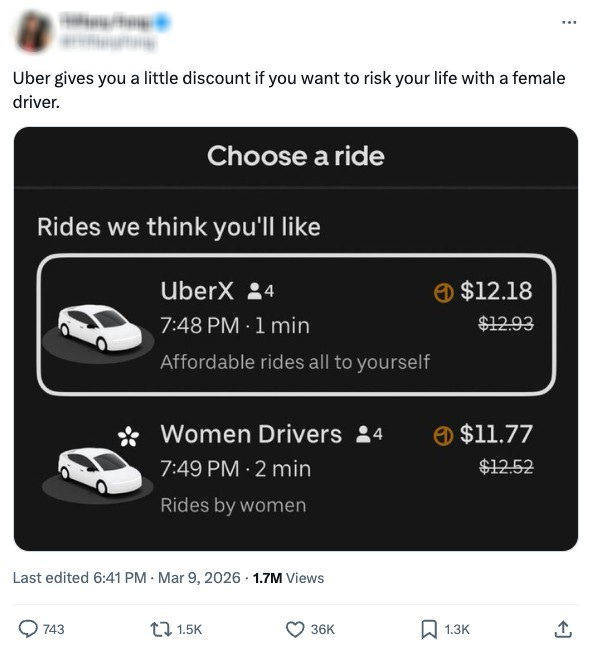
Suddenly the feature looks like rides with women drivers are cheaper.
Which then invites jokes like the viral thread suggesting you’re “risking your life with a woman driver”.
The product may be optimizing feature adoption or adjusting pricing based on demand, but the signal people see can easily turn into a statement about the perceived value of women drivers.
Surge pricing during hurricanes
Another example from Uber is how high prices appear during disasters due to their surge pricing model.
The logic is textbook marketplace design:
demand spikes
prices increase
more drivers are attracted to the area
In theory, surge pricing helps people get rides faster during emergencies.
But during hurricanes and disasters, people are unlikely to interpret this as supply balancing. What they perceive instead is profiting from a crisis.
The optimized metric might be supply-demand equilibrium, but the interpretation becomes opportunism.
Apple Batterygate
Almost everyone heard “Apple slows older iPhones on purpose to force people to buy newer models” from someone at least once, if not thought it themselves.
In reality, as batteries aged, they struggled to supply enough power. To prevent the phone from excessive power consumption and random shutdowns, iOS throttled performance, which could lead to slower app performance overall.
From an engineering perspective, this made a lot of sense.
But as the rumors showed, users didn’t see this as an optimization for their older phones. They saw intentional obsolescence.
Even though the product decision was technically reasonable, the signal it sent damaged trust and made users question the brand.
Apple later introduced battery health transparency and battery replacement programs to address these concerns.
Airbnb’s smart pricing
Airbnb introduced smart pricing recommendations to help hosts increase bookings.
They suggested lowering prices based on demand patterns.
From a platform perspective, this improves:
booking rate
liquidity
marketplace efficiency
But many hosts interpret it differently.

They felt Airbnb was pushing them to undervalue their homes.
The platform-wide metric Airbnb was trying to improve was more bookings. The interpretation at the user level was that Airbnb was trying to optimize its revenue at the cost of the hosts’.
Product Challenge
When product decisions affect people’s identity, safety, or control over their business and revenue, interpretation becomes part of the product.
Don’t blame your users for not seeing the “big picture” and the optimization model behind your decision.
What matters most to them is that single moment when they use your app, or the main reason they use your product:
Their own benefit.
The signals they receive from your business decisions will shape their trust.
When building products, it’s not enough to ask:
Is this the right metric?
You also have to ask:
What story will this decision tell?
Because sometimes the metric improves while the signal quietly moves in the opposite direction.